By Dr. Silja Litvin, PhD — Clinical Psychologist & Executive Coach
Where Are You on the Persistence Performance Curve?
Stuck, thriving or running on empty? Finding your place on the Persistence Performance Curve

A client of mine sold their company for a very large sum and thought they would enjoy their time off, finally free from stress, deadlines and the many parts of the business that had never interested them but had become the biggest part of their job.
After a few years, they found their drive had fizzled into nothing. They were lethargic, and even writing one email a day felt insurmountable. Yet they knew they needed to do something with their life, lest they fall into meaninglessness. They had an idea, they had contacts, they had money, but their days filled up with small things that didn’t help them work towards their new goal.
That wasn’t them. They didn’t recognise themselves. Usually, it was hard for them to pump the brakes. What had happened?!
Depending on where we are in our lives, and what has led us there, we might find ourselves at very different points on what I call the Persistence Performance Curve – and the mobility to move towards the middle is what enables resilience and personal growth.
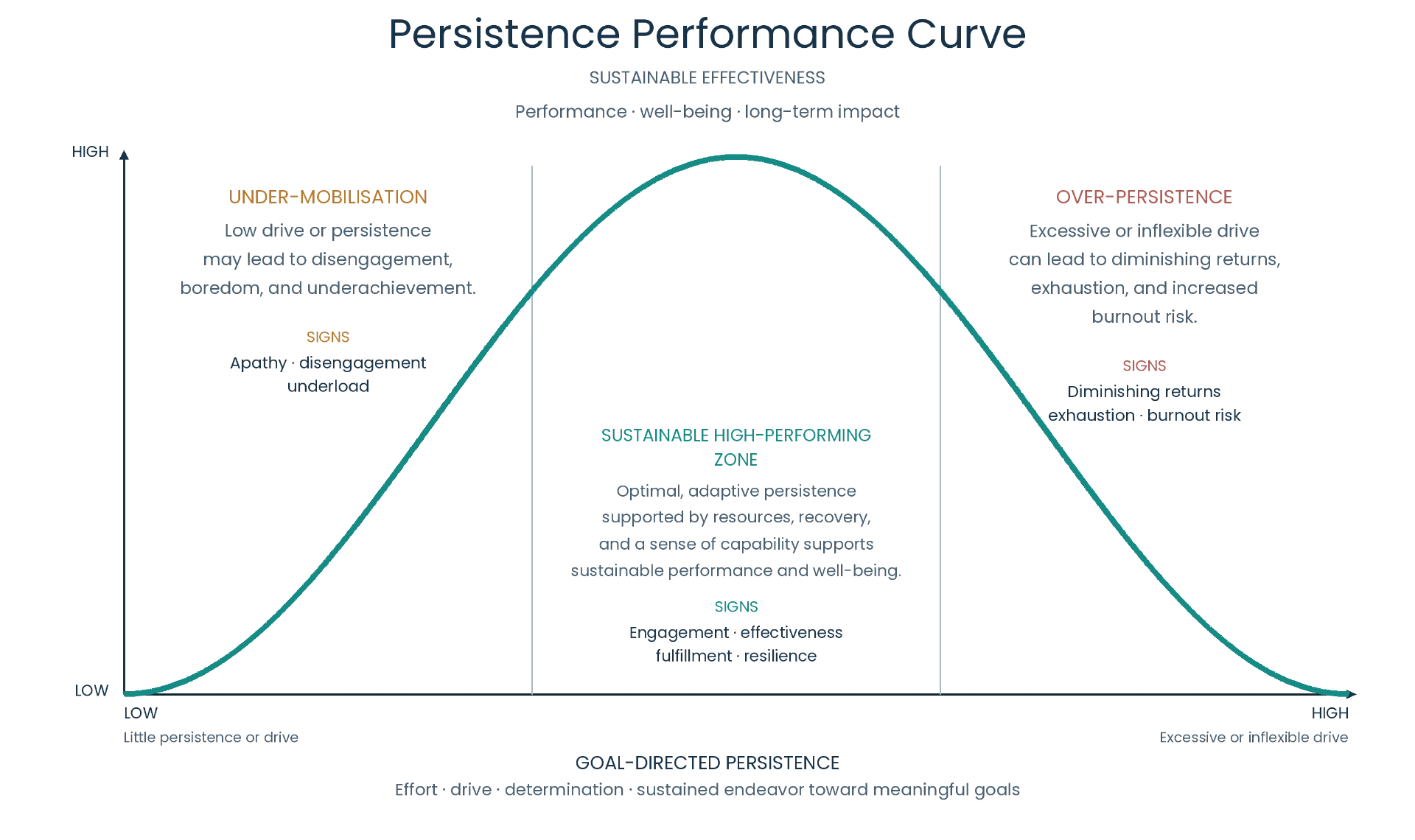
(Note: Find out where you are on the curve.)
Along the bottom runs goal-directed persistence, from little drive to excessive or inflexible drive. Up the side runs sustainable effectiveness: performance, wellbeing and long-term impact. It rises, peaks and falls across three zones: under-mobilisation, sustainable high performance and over-persistence. The patterns it describes are changeable, not personality types, and you may sit in one zone at work and another at home. The useful response depends on where you are.
Zone 1 — Under-mobilisation: getting moving again
The signs: tasks that keep sliding, a flat feeling about work that once mattered, a quiet sense of underachievement. The question to ask is not "why am I so lazy?" but "what, specifically, is stopping me from starting?"
Think back to the client above. They want to return to the world of building ideas into tangible businesses, but every attempt stalls. The obstacle is not effort; it is the fear of not being able to replicate their previous success, combined with days that have no structure. Finding the real obstacle within our coaching sessions, whether uncertainty, overwhelm, a skills gap or practical constraints, is the key to escaping the under-mobilisation zone. Once you can name the obstacle, it shrinks into a size that you can overcome.
Do you find yourself in Zone 1? Three things to try:
- Shrink one meaningful goal to a scheduled action. "Return to work" becomes "rewrite the first two lines of my CV on Tuesday at 9am". Behavioural activation, built on this logic, has solid trial evidence for lifting activity and mood in people with depression. For a stuck leader, it is an experiment that has worked every time.
- Make a when–then plan. "When I finish my coffee on Wednesday, then I will message one former colleague." Research on if–then planning shows that linking a specific cue to a specific response makes follow-through more automatic than intention alone.
- Arrange support that matches the obstacle. For my client, a fortnightly call with a former peer who had just got back into the game and was going through their own growing pains was inspiration enough – and watching that peer accept the uncertainty was eye-opening. Support shrinks the fear; it does not remove the work.
After seven days, count actions completed, not feelings. My client felt no more confident by Friday, but they had sent two messages and booked one coffee. After six weeks, they were surprised to find themselves halfway into the project they had been sitting in front of for two years – and firmly at the start of the sustainable high-performance zone.
Zone 2 — Sustainable high performance: developing excellence
If you are engaged, effective and recovering well, there is nothing to fix. The opportunity is to refine and expand what you can do while protecting what works. The question here is: which capability will the next chapter demand that I do not yet have?
Another client was a divisional leader preparing for a promotion that would move their family to Singapore. They were high-energy, well-balanced, and a thoughtful leader, but they were also thinking ahead, anticipating that a new country and a bigger role would have an unforeseeable impact on them and their family. They were thriving, which is exactly why they wanted to use the next six months deliberately.
Do you find yourself in Zone 2? Three things to try:
- Name one capability the next role requires. One, not five. For my client, it was influencing a board they did not yet know, in a culture they did not yet understand.
- Practise it in real situations and ask for precise feedback. Vague praise teaches little. A meta-analysis of 435 studies found that feedback's effect depends heavily on its information content: telling you what to do differently next time beats simple approval. That evidence comes from education, so treat it as a steer, not a prescription. My client asked a trusted board member for one thing that landed and one that did not, after every meeting.
- Review one recurring assumption. My client noticed they read silence as disagreement. Testing that belief in two conversations changed how they opened them.
A word on perfectionism. Striving for excellence and fearing mistakes are different things. A two-wave study of workers found that perfectionistic concerns – the worry about judgement and failure – predicted later burnout, whereas striving itself did not. Keep the striving; interrogate the fear. Guard your recovery while you stretch; it is what keeps you here.
After a week, ask two questions: did I practise the capability at least twice, and was the feedback specific enough to act on? If not, the plan needs sharpening, not more effort.
Zone 3 — Over-persistence: creating boundaries and flexibility
Here, effort has become the problem. The signs: diminishing returns, exhaustion, poor sleep, irritability at home, and a sense that you alone hold everything together. The question to ask is: what am I afraid would happen if I stopped?
A final client, a COO with a capacity that shocked me from day one – how could one person manage so many workflows alone? – was flirting with burnout and exuded such nervous energy that, in our first few sessions, even I found myself regulating my breathing. Much of their capacity was what I call ‘stolen’, though: they were answering emails at midnight, sleeping badly, and were short and irritable at home. They believed constant availability is what commitment looks like. That belief was the first thing to examine, and what we spent most of our time talking about, because it makes every boundary feel like a betrayal.
Three things to try:
- Remove or delegate one commitment this week. Pick something you do because nobody else has been asked.
- Negotiate priorities with a boundary sentence (even with yourself). "I can deliver X by Friday. If Y becomes the priority, we need to move Z." This returns the workload decision to the people who set it.
- Build a realistic stopping routine. A fixed finish time three evenings a week, with a two-minute note of what is unfinished so the mind can let go. Across 198 samples, recovery from work is associated with better wellbeing and performance, and interventions to improve detachment show effects. Worth trying.
One caution. Burnout is not a failure of self-care. The job demands–resources literature shows it arises from the balance between a role's demands and the resources available to meet them. If demands are structurally unreasonable, personal routines will only go so far; the conversation belongs with your organisation. And if exhaustion, sleep problems or impaired functioning persist, please speak to your GP or a psychologist.
The COO’s review with me after one week came down to three questions: did I stop at the agreed time at least twice? Did I say the boundary sentence once? Did anything actually fall over? Usually, nothing does.
One question to take with you
Whichever zone you recognise, the question is the same: what kind of adjustment would help me most right now? More activation, sharper refinement, or firmer limits?
For a structured way to reflect, complete my Persistence and Sustainable Performance Questionnaire. It is a research-informed reflection tool, not a validated assessment or a precise measure of where you sit on the curve. It will help you notice your pattern and choose a next step.
References
Bakker, A. B., Demerouti, E., & Sanz-Vergel, A. (2023). Job demands–resources theory: Ten years later. Annual Review of Organizational Psychology and Organizational Behavior, 10, 25–53. https://doi.org/10.1146/annurev-orgpsych-120920-053933
Bieleke, M., Keller, L., & Gollwitzer, P. M. (2021). If-then planning. European Review of Social Psychology, 32(1), 88–122. https://doi.org/10.1080/10463283.2020.1808936
Karabinski, T., Haun, V. C., Nübold, A., Wendsche, J., & Wegge, J. (2021). Interventions for improving psychological detachment from work: A meta-analysis. Journal of Occupational Health Psychology, 26(3), 224–242. https://doi.org/10.1037/ocp0000280
Spagnoli, P., Buono, C., Kovalchuk, L. S., Cordasco, G., & Esposito, A. (2021). Perfectionism and burnout during the COVID-19 crisis: A two-wave cross-lagged study. Frontiers in Psychology, 11, 631994. https://doi.org/10.3389/fpsyg.2020.631994
Steed, L. B., Swider, B. W., Keem, S., & Liu, J. T. (2021). Leaving work at work: A meta-analysis on employee recovery from work. Journal of Management, 47(4), 867–897. https://doi.org/10.1177/0149206319864153
Stein, A. T., Carl, E., Cuijpers, P., Karyotaki, E., & Smits, J. A. J. (2021). Looking beyond depression: A meta-analysis of the effect of behavioral activation on depression, anxiety, and activation. Psychological Medicine, 51(9), 1491–1504. https://doi.org/10.1017/S0033291720000239
Wisniewski, B., Zierer, K., & Hattie, J. (2020). The power of feedback revisited: A meta-analysis of educational feedback research. Frontiers in Psychology, 10, 3087. https://doi.org/10.3389/fpsyg.2019.03087
- Persistence
- Sustainable Performance
- Leadership
- Resilience
Do you want to see if Dr. Silja Litvin's experience as an executive coach is the right fit for your current challenges?
Confidential, unhurried and without obligation. Prefer email? silja@drsiljalitvin.com